Axis 1 - Sustainable Orientation
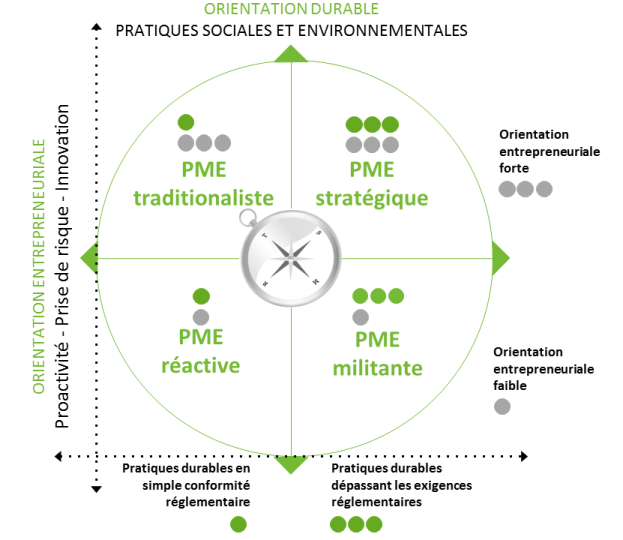
Sustainable orientation is defined by social and environmental practices, social practices in human resource management, and societal practices in community relations. The degree of commitment to these practices allows for the distinction of typical behavioral profiles.
Environmental Practices:
Observed environmental practices in SMEs indicate two poles of organizational behavior in this area. On one hand, there are companies that comply with environmental and societal legislation without exceeding regulatory requirements. On the other extreme, companies promote sustainable development practices that far surpass those mandated by regulations.
Social Practices in Human Resource Management:
In the context of SMEs, social practices relate to relationships with employees. Concretely, this concerns human resource management, many aspects of which are strongly codified by law. However, each SME has a certain latitude in this matter and can adopt behaviors that do or do not contribute to sustainable development.
Societal Practices in Community Relations:
The third dimension of sustainable orientation relates to the relations between the SME and its community. Qualified as societal or community practices, investments in the local environment and local engagement touch upon both social and economic aspects.
Several practices observed in SMEs that contribute to sustainable development, identified in the global scientific literature, are assessed by the questions in the Sustainability Compass for SMEs to verify their level of implementation in your SME.
Axis 2 - Entrepreneurial Orientation
Regarding entrepreneurial orientation, it is a concept perfectly suited to the situation of SMEs. The entrepreneurial act is intimately linked to the idea of an SME since it is its founding impetus.
Proactivity, Risk-Taking, and Product Innovation:
Entrepreneurial orientation refers to a repertoire of organizational behaviors in strategy and decision-making. These organizational behaviors are articulated along three dimensions: proactivity, risk-taking, and product innovation. These behaviors can be linked to the idea of performance, one aspect of sustainability.
The entrepreneurial dimensions have been measured for several years using questions developed by researchers Covin and Slevin in 1989. The Sustainability Compass uses this series of questions to help you position your SME on this axis.
An evaluation of these aspects allows for the distinction, on a continuum, between the most entrepreneurial and the most conservative profiles. Companies’ innovation strategies are then seen as responses dictated by the environment (conservative), or as emanating from the convictions and voluntary initiatives of the managers (entrepreneurial). Proactivity (entrepreneurial) is seen as the opposite of reactivity (conservative). Risk-taking is considered a concrete reflection of a proven willingness to maximize development opportunities.